
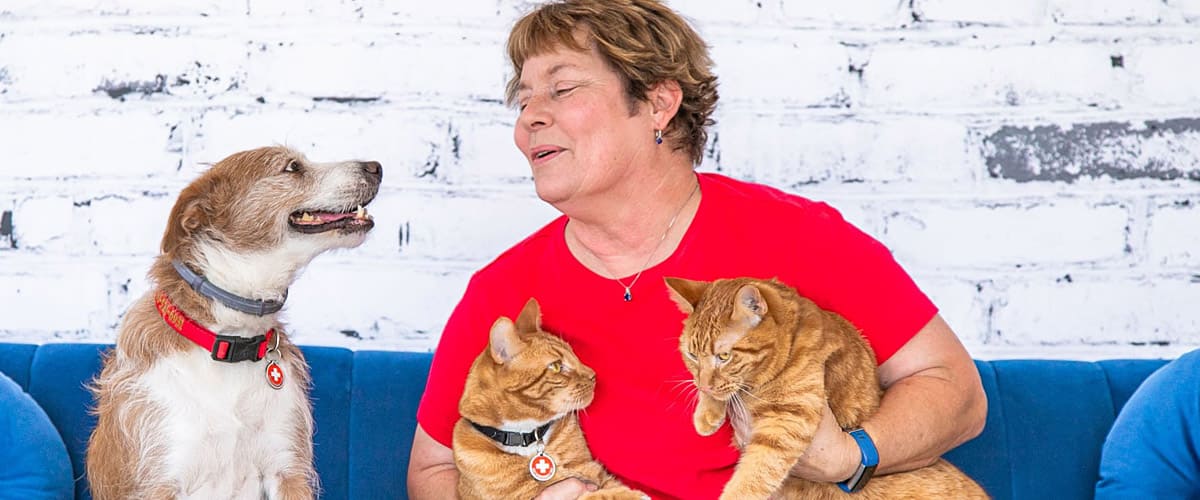
Animal Behaviorist Dr. Annie Valuska Dishes Up Insights for the National Dog Show Airing on NBC on Thanksgiving Day


More than 2,000 dogs representing 208 breeds will compete for the Best of Show honors at the upcoming National Dog Show in Philadelphia, which will be televised on Thanksgiving Day on NBC-TV. Oh Behave show host Arden Moore interviews Dr. Annie Valuska in this special episode. As a certified applied animal behaviorist, she truly understands dog behavior. She is also the "voice of the pet" at Purina. Tune in as Dr. Valuska unleashes science-backed observations about show dogs as well as tips to bring out the best in family pets during the upcoming holiday season.
Listen to Episode #584 Now:
BIO:
Dr. Annie Valuska is a principal scientist on Purina’s Pet Behavior team and a Certified Applied Animal Behaviorist with more than 20 years of experience advancing insight into animal behavior, wellbeing and human–animal relationships. She serves as the “voice of the pet” within Purina, helping ensure that the behavioral and emotional needs of cats and dogs remain central to product development, research and outreach.
Dr. Valuska earned her PhD in Animal Behavior from the University of California, Davis, following undergraduate research at Kenyon College, and later completed postdoctoral work as a Behavior Research Fellow at Disney’s Animal Kingdom. Since joining Purina in 2013, she has applied her scientific expertise to better understand pets’ everyday experiences and translate those insights into meaningful benefits for pets and the people who love them.
Her passion for animal wellbeing extends beyond her professional work. She is an award-winning animal shelter volunteer and board member, and she shares her home with Arya, a rescued pit bull Chihuahua mix, and Jack, a black rescue cat. She also connects with pet owners on social media (TikTok, Instagram), where she shares behavior insights and practical tips.
Transcript:
Hey, paws up, pet pals. Welcome to the Oh Behave show on Pet Life Radio. I'm your host, Arden Moore.
Did you know that there are more than 200 recognized dog breeds? I mean, we're talking about itty-bitty chihuahuas to the big cane corso's. You know, dogs definitely put the capital D for diversity. Now, our special guest today really knows dogs.
She has a Ph.D. in animal behavior science, and I'm laughing because I always think of Ph.D. as pretty happy dog, but for her, it's the hard Ph.D. She also serves as, I love this title, the voice of the pet at Purina. She's here today to address that burning question. Do dogs really enjoy participating in the show ring at dog shows? So, here with the answer and much more is, back on our show, Dr. Annie Valuska.
Welcome back, Dr. Annie. Thank you, happy to be here. All right, we're going to dig into this very upcoming dog show.
It's the National Dog Show in Philly. It is brought to you by, god, and the Philadelphia Kennel Club. After we take this quick break, you all know the drill.
Sit, stay, we'll be right back. Welcome back to the Old Behavior Show on Pet Life Radio. I'm your host, Arden Moore.
Dr. Annie Valuska is in the house. She is a certified applied animal behaviorist, and yes, the voice of the pet at Purina. That's a pretty cool title.
What do you think of that title? It's not this big, long, hairy, blah, blah, blah, blah, blah, blah. Voice of the pet, I mean, what do you think of your title? Well, I have a big, long, blah, blah, blah title as well. But I think the easiest way to explain what that blah, blah, blah title actually means is that I get to be the voice of the pet of the company.
It's my job to understand how dogs and cats experience the world and what their needs are, and then I serve as kind of a translator and make sure that those needs are being met by all my colleagues that I work with. I love it. I love it.
And, you know, Dr. Annie is here to shed, yeah, I did say the word shed, some light on what purebred dogs really think about strutting around the show ring to try to vie for Best of Show honors. Your timing here is perfect because I believe there's over, what, 2,000 dogs representing 208 breeds at the National Dog Show in Philadelphia, November 14th and 15th. Can you tell us a little bit about that, Dr. Annie? I can tell you about the experience of the show in general.
That's what you want to know about. So I'm a relative newcomer to the dog show world, I have to admit. I only started going within the last 10 or so years.
Well, that's pretty decent. Well, you feel like it's decent until you get there and you talk to these handlers and breeders and other people that are really in this world and they have been a part of this world for, you know, decades. They know so much about these breeds and about showing.
And so, yeah, I still feel like a bit of a newbie. But it is, if you've never had the opportunity to go to a dog show, I highly recommend the experience. There's nothing else like it.
Well, the one we're talking about for this show is the National Dog Show. I believe it's its 25th year. Is that correct? Yes.
Okay. And it's in Philadelphia at the Greater Philadelphia Expo Center. Purina and the Kennel Club of Philly are putting it on.
I mean, we love dogs. But what do you think when there's like over 200 dog breeds? Let's just get to that first. Cats, there's like 40 some, you know.
But we have manipulated the genes for dogs to fit in our hand and others that probably can fit us in their paw. So when it comes to the species, Dr. Annie Valuska, what's your take on diversity in dogs? Yeah, it really is fascinating and a testament to how much humans have been involved in dogs evolution. And as a behaviorist, the wildest thing to me looking around at a show like that and seeing all of that diversity is that, yes, they're all the same species.
They have all been through the same process of domestication. So ranging from those tiny little chihuahuas, like you mentioned, or a Pomeranian like I have at home. Shout out to Rocky, which is so appropriate that it's Philadelphia's show.
Yes. And, you know, from a Pomeranian to a Great Dane, they are the same species. And studies tell us that behaviorally, they are a lot more alike than they are different.
Really? Can you expand on that? I'm curious as a cat for that. Yeah. There's, as ever, been much less work in cats than dogs on this topic.
But we have this diversity of breeds, many of which have been selected for specific behaviors, like herding or retrieving or guarding. And so there's been a lot of work done on trying to understand the genetics behind those specific traits that we've been selecting for. And also whether there are breed level differences in larger scale behaviors, like trainability or agreeableness or those kinds of things.
And with a few exceptions, mostly motor patterns like the pointing or the herding, for example, those are highly heritable. But for general behaviors like trainability or things you might think of like stubbornness or reactivity or aggressiveness, there is not a lot of evidence that there are large scale breed differences in those traits. Really? That's cool.
Yeah. Dogs within a breed can have as much variability in temperament as dogs between breeds. Right.
There can be a very, very calm chihuahua, and there could be a very boisterous Bernese Mountain Dog, right? Yes. Okay. So you've got a little bit of science, but you also have experience, right? Absolutely.
Exposure to things. So let's dive in and have some fun with the breeds. Okay.
I had a Corgi, Jazz. I say Corgis are a cross between Robin Williams and the Three Stooges. They are brilliant comedians, but boy, did he like to herd and boy, did he like to give his opinion on a decision.
But then I've had other dogs that are, I have a current dog who has 20 different dog breeds. We did the DNA, everything from a Pomeranian and a Pit to a Great Pyrenees, and she weighs 25 pounds. Wow.
And she has six toes on each back leg, and her name is Nova Six Toes. So how much does heredity and genes play as compared to exposure, life's experiences? Yeah. Experience certainly plays a big role, and that is another thing that is on full display at the National Dog Show.
For as much variability and diversity as you might see in their physical appearance, consistently every dog there has had outstanding socialization. They have all had this fantastic foundation of training to prepare them to enjoy events like the dog show, to enjoy being around other dogs and lots of people and those kinds of things. And so that experience, that socialization, that specific kind of training makes a huge difference in terms of a dog's ultimate behavior when they're adults.
And so I like to think of breed as something that kind of drops a dog on a certain place on a scale, depending on what behavior you're talking about, say trainability. Yeah. Okay.
So give me a breed example, just when you're doing this. Okay. So for example, golden retrievers have a reputation for being highly trainable.
Right. There are a lot of service dogs out there that are goldies. Yeah.
Yes. And I grew up with goldens, like I can vouch for that. And so their breed on the scale of trainability, those genetics are going to drop them pretty high up on the scale of trainability, but it's still a scale.
And so the experience that that dog has throughout their life is going to move them up or down on that scale of trainability. And that's true for pretty much every behavior you can talk about. So a breed that has maybe a reputation for being a little less biddable, like say a husky.
Oh, I had a husky mix. Yes. Go ahead.
Keep going. So the husky might start out in a different spot on that scale. The golden retriever may have a bit of an edge in terms of where they land, but through experience, it's still possible to nudge a husky higher up on that trainability scale to the point where there's going to be overlap between where all the huskies land versus where all the golden retrievers land.
So it really is a combination of those inherited breed traits and the experiences and training that those dogs receive throughout their lifetime. I'm so happy you just gave those two examples, Dr. Annie, because I had a husky-golden retriever mix named Chipper, and I teach veterinary-approved pet first aid, and she was my first safety dog. I adopted her when she was two from a husky rescue, and she jumped my six-foot fence the first day.
That's a husky. Yep. But she went to the front door and pawed it.
That's the golden. So the husky wanted to roam in her and the golden wanted to be home, and it just took her a minute to kind of like, oh, this is my home, and she did shed certainly a lot. So I love that.
I love that. So these dogs are coming to the show, and to reach this plateau, the national dog show, this isn't their first dog show. They've had a lot of miles, right? Yes.
So I love that Purina is like, can we just get in the dog's mind for a minute? So you're the voice of the pet. So here I am. I'm a Pomeranian, or I'm a Jack Russell, or a Parson Russell, sorry, or some other breed.
What's going on in my mind when I look, smell, see? What's going on when I get to the show before the whole festivities? What's going on in that dog's mind? So I think a lot of the trip to the show is just like any other trip. All of these dogs are good travelers. It's likely that they enjoy that experience.
Most of them have very cushy travel digs, and they get to spend time with their people on that journey. And so I think for these dogs, dogs in general are very sensitive to context. So they are likely aware that they are at this kind of event, this dog show that we do several times before.
What may differentiate their experience at the National Dog Show versus all of the shows that led up to it is what is at stake for the human, because dogs are very sensitive to context, and they are also very sensitive to us. They're smelling our emotional state, right? Yes. Not only are they smelling our emotional state, they can interpret our facial expressions, our tone of voice.
Yeah, they are cuing in on all of that. So if there is a difference in how the dog reacts at National Dog Show versus, say, a smaller dog show, it is likely because they are picking up that their human thinks this is a bigger deal than any other dog show they've been to. You got to give some tips to these people showing their dogs, what's their do's and don'ts, that we can use on a walk with our dog or taking our dog to see our family for the holidays.
What are some tips you can offer our folks that show dogs and people who have dogs? I'm going to let you pause, see I said pause, just for a second because I want you to come with that answer after we take this quick break. So sit, stay, we'll be right back. Welcome back to the O'Behave Show on PetLife Radio.
I'm your host, Arden Moore. Our special guest is a great gal. Her name is Dr. Annie Valuska.
She is the voice of the pet at Purina. She is a certified applied animal behaviorist, and she's helping us about getting inside the minds of dogs, whether they're at a dog show or they're in a car and going to a family holiday visit or out and about with their people on a leash. So what are some tips, Dr. Annie, you can give us humans to make this experience a little less stressful and more welcoming for these great canines? Yeah, I think trying to keep their experience in mind goes a long way.
Put on your behaviorist hat, try to think like a dog and understand that if you're going to a new friend's house, for example, or if you're having people over, that might be exciting for us, but to your dog that might mean some stressors, that might mean some things being introduced in the environment that could be hazardous if they get into a bag or some food slinging around. So really trying to see the experience through the dog's eyes is a big one. And then another lesson I think we can take from the dogs and their handlers at the National Dog Show is make sure that the dog is also having a good time.
Part of the training that has gone into these show champions is teaching them to enjoy these experiences, that being at an event like this is a good thing for them. They get lots of play with their handler, they get extra treats, they get attention, those kinds of things. There's something in it for them.
And I think that's a great lesson to bring home when we are socializing our own pets, trying to get them comfortable with these kinds of experiences around the holidays, is make sure that you are making it a good experience for them. Pair that association with their favorite treat, make sure they're getting some extra snuggle time from you, whatever it takes that your dog really enjoys and finds positively reinforcing, make sure that's a part of the experience for them. So sometimes we're only human, Dr. Annie, and we get frustrated or we do that or something.
So how do we handle stress and ourselves so it doesn't spill over to our dog in the show ring or out and about? If I had the answer to that, I would love to share it with you. I mean, I sometimes catch myself, I just stop and take a breath. I don't know, but that's probably silly, right? Yeah.
I think trying to avoid stress entirely is, that's not going to happen. Even at the National Dog Show, those professionals, they're still going to be experiencing those emotions. The great thing about dogs is that they really do live in the moment.
So don't beat yourself up if you do have a moment of stress. The best thing you can do for yourself and for the dog is just to move forward and try to get into a positive space. And I think that dogs, at least for me, are great at reducing my stress.
So not only taking a deep breath, but even building in some time to just look into their eyes, pet them, just enjoy that moment with you. It reduces my blood pressure, reduces my stress. And if you can make that a part of a routine so that you know that at a specific time of day, for example, you're going to have that little moment of connection and relaxation, I think that really amplifies the benefits too for you and your dog.
Come on, you know these dogs know they're up for a big prize. Don't you think most of those dogs strutting around the ring, I get a kick out of seeing the ones that just have a little extra joy to their step. Are they competitive or are they just excited about the whole opportunity? Do they care if they win best of show or what? So scientifically, I don't think there's any evidence that dogs can feel competitive in the same way that the humans in the ring do.
On the other hand, I do think they are aware that there is something different about this show due to the feelings of the people around. It's likely that the cameras that you see that allow us at home to get such a great view of the show on Thanksgiving, those probably haven't been present at other shows in the past. And that's one of my favorite things to do when I go is to watch the dogs notice the camera for the first time and see some of their responses to it.
So there's certainly something different about the National Dog Show. You know, they are 21st century dogs. They may not have thumbs to operate our phones to video, but they know a camera, don't they? They know there's something different about that.
Yeah. And the more you take photos and videos of your pet, the more I guess they become comfortable and maybe they bring out their inner ham. Especially if they know that when you pull that camera out, there's a treat involved.
I am known around the block as treat lady. So I think just saying that word too. So do you have a favorite breed? Are you rooting for a certain one? Are you going to be Switzerland here? You know, I've always loved golden retrievers because I grew up with them.
I think this year because of little Rocky, I might be rooting for the Pomeranians. And what do you like about Pomeranians? You know, they are related to huskies and those spitz breeds. And so he's in this, they all are in these adorable, fluffy little packages.
They have such a big personality. They seem to have no concept that they are only, you know, five pounds. Is that how big Rocky is? He's still a puppy.
He's five months. So he's five pounds right now. He may get a little bit bigger.
Now he's joined by two other pets. They'll be very offended if you don't mention your other pets and what they are. Yes.
So his big sister is my dog, Aria. She might also have about 20 breeds in the mix, but the top two are Pitbull and Chihuahua. Isn't that crazy? But fun? Yes.
She's a, she's a character. What's her personality like? She is, she's kind of a bark first, ask questions later kind of gal. And how big is she? She's about 40 pounds.
Okay. And what about meow? You got another one. Jack, my cat, he is a black cat and he's, he's actually the second biggest in the house.
He's about 18 pounds. Does he have some Maine Coon in him? I don't know. I haven't gotten DNA.
Or does he just like to eat a lot of Purina? No, he is. Hey, I'll have you know, my vet colleagues make sure that he is in excellent body condition. He is just a big cat.
Those are fun, aren't they? When you have a big cat, is he a cuddler? Yes, he is. And does he run the show or how's the dogs? Oh, absolutely. Jack is in charge.
Yes. Okay. So we asked this of all our guests, and we put these as short little vignettes on O Behave Show and my YouTube channel, which is Arden Moore.
If you, Dr. Annie Valuska could have a pet superpower, what would it be? And why? I would love to be able to, to talk to them. I mean, I've spent my, my career. That's what I've, what I'm trying to do through science now and body language and all that stuff.
But if I had the superpower to just be able to read their minds and make sure that they understand what I'm trying to tell them, I think that would be incredible. I love that answer. I love that.
How do people find out more about the National Dog Show, Purina, and you, Dr. Annie Valuska? So Purina has lots of information available on our website, Purina.com. I believe the National Dog Show also has a website with more information about that. Of course, they can tune in noon on Thanksgiving day across all time zones and watch it for themselves. And how about you? How do we find out about you? You can get more tips on pet behavior from my social media accounts.
I am at Annie Knows Animals on TikTok and Instagram. All right. I'm going to be following you.
At this time, I also want to give a shout out to my producer, Mark Winter. He is the executive producer of Pet Life Radio. We are the largest pet radio network.
And humbly, you are tuned in to the O Behave Show, the longest running weekly pet podcast on the planet. Believe it or not, Annie, we've been on the air since 07. Wow.
When I'm not behind the mic, my passion is to help people know how to keep their pets safe and how to save their lives. I'm a master certified Pet First Aid CPR instructor. I work with many of the top ER and critical care veterinarians.
And our classes are fun and practical because nowhere is it said that Pet First Aid has to be scary or boring. And you know why it's not boring, everybody? Because I have not one, not two, but three well-mannered, well-trained pets as my safety team. Pet Safety Dog Kona, Pet Safety Dog Nova Six Toes, and wait for it, Pet Safety Cat Casey.
If you do an AI search, they declare Casey is the world's busiest safety cat. And he's an orange tabby, Dr. Annie. So you can file that information at Pet First Aid for you.
So until next time, this is your flea-free host, Arden Moore, delivering just two words to all you two, three, and four-leggers out there, O Behave.
Transcribed by TurboScribe. Go Unlimited to remove this message.
"Oh Behave " Theme Song Written & Produced by Mark Winter
© Copyright Such Fun Music (ASCAP)