
Phantoms, Cadillacs & Claws — Crime Solving Through a Cat’s Eyes



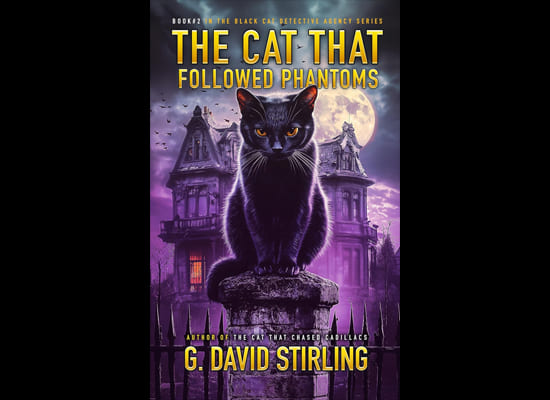
On this episode of Cattitude, Michelle Fern sits down with author G. David Stirling, creator of the wildly imaginative Cat Detective Series, including The Cat That Chased Cadillacs and The Cat That Followed Phantoms. His feline hero, Buck, is a black-cat detective with a secret agency beneath a backyard shed, solving crimes right under the nose of his human — the town’s only detective — who has no idea his cat is the real brains on the case! David shares how his real-life black cat, Panther, inspired the character, the surprising depth of feline intelligence and behavior woven into his mysteries, and why these books celebrate black cats instead of stereotyping them. If you love crime novels, fantasy, cozy mysteries, or simply adore cats with big personalities, this episode is a must-listen.
Listen to Episode #285 Now:
BIO:
G. David Stirling is the author of The Black Cat Detective Agency books, starring Beckett Buckleberry. He lives in the mountains of North Carolina with his wife, near the fictional town of Copper Summit. They have two cats — one black and one gray. They don’t solve mysteries.
Transcript:
Hello, feline friends, welcome to Cattitude. I'm your show host, Michelle Fern, and today I have a really cool show for you. If you like books and you like cats, of course you like cats, right? You're listening to Cattitude.
Then you're gonna love my show with this author. So stay tuned, we'll be right back. Welcome back, everyone.
I'd like to welcome David Stirling. He is the author of The Cat That Chased Cadillacs and The Cat That Followed Phantoms. Welcome, David.
Thank you, Michelle. It's great to be here, thank you. I'm very excited to have you on.
So before we get started in talking about your books, you must love cats. I do love cats, yeah. Ever since, honestly, when I was a baby, even before I was born, we had a cat.
There you go, it's starting in the womb, so there you are. And did you know your protagonist in both books is a black cat? Yes, his name is Buck. He's a black cat detective and he lives in a little mountain town in Northwestern North Carolina.
Okay, does it follow you a little bit? Yeah, I guess you could say that. I rescued a cat, a black cat, named Panther. And gosh, since he was two weeks old, I mean, his eyes were barely open and I could hold him in the palm of my hand.
And over the years, I've come to realize that how black cats are so mischievous and curious more than any other cat I've had, I think. People say that orange cats are kind of the same way. But yeah, I based Buck on my cat, Panther.
I love it. I love that you're showing a cat in a way that it's not just stereotypical black cat, you know? Because the stereotype of black cat is always scary and stay away and this, and your cat is intelligent and insightful and is curious and all of that. And you know, I don't have a solid black cat.
I have a tuxedo, Molly, and she is not that curious. So maybe it is the all black. I don't know.
Dennis is part Maine Coon. He's pretty curious. Wow, yeah, Maine Coons are fantastic.
So let's talk about your books. What inspired you to create a series? Because you have two books and you're, I'm sure there's more coming. So a series about a cat that chases Cadillacs or follows phantoms.
The cat actually has a detective business. He does. Yeah, he owns his own detective agency.
His owner is the town's detective and it's a very small town. So there's only one detective. There's only a handful of police.
And he has no idea what his cat, Buck, is up to. Buck is an indoor, outdoor cat. He has his own detective agency underneath of the shed in the backyard.
So his human, Detective Shaw, has no idea of the secret life of Buck. He doesn't know that he talks, that he helps him solve crime, that he places clues on his desk every once in a while in order for him, Detective Shaw, to figure out the solution to whatever crime they're involved in. And I don't think that's ever going to change.
He's probably going to remain a secret hero. Okay, I love it. It borders on, let's see if I can say this right, anthropomorphism.
Yes, yeah, you're right. You know, before I knew what the word meant, many years ago, I wrote a paper and used this type of style and learned about it. And it's interesting.
So did you always have an affinity for anthropomorph? I'm just going to say it a few times and once or twice it'll sound right. So did you have a need for anthropomorphism or did you, it just kind of just worked out that way? No, I think I've always been of a mind, even as a kid, that animals were, you know, intelligent enough to, gosh, I don't know, have their own lives, right? Like when I was little, I remember watching the Dr. Doolittle movie, not the Eddie Murphy one, but the Rex Harrison one based on the original novels. And after I saw that movie, and I was only like, I don't know, Michelle, I started to read early.
So I was young. And I remember my mom had gotten me the, like a collection. So there were like, I don't know, five or six paperbacks in this collection.
I just devoured them. And then when I was a little bit older, I saw the Watership Down movie. And wow, honestly, as a kid, that was a little bit traumatizing, but I wanted to know more about that world because like you're saying, the anthropomorphism in it is just so intriguing, especially when you have pets because you as their caretaker, their owner, you know that they have their own lives and their own thoughts.
And these books and these movies give you an opportunity to dive deeper into all of that. So I read the Richard Adams books and just as a kid loving animals and wanting to be a vet or a marine biologist or something, I would just eat this stuff up. So when it came time for me to actually write a book, I've had short stories done before, but I've never done a book.
It's just a larger endeavor. I thought, you know what? I'm gonna go back to my first love, which is animals and in this specific case, a cat. Okay, let's talk more about Buck.
Sure. How did you decide to define him? I mean, he's a detective and so that shapes his characteristics somewhat, but did you base him a little bit on your cat? Well, you did cause he's black cat, same black cat, right? How did you go about giving him these other distinct personality features? That's a great question. Well, yes, Buck is based on my cat, Panther, but he's also based on what I like.
I love crime fiction. So he's a little bit of James Bond. He's a little bit of, you know, all these noir detectives.
He loves Miles Davis. He likes a good cup of tea. He has all these qualities to him that you can see from these noir films or old dime store detective novels.
That's Buck. So he's a little bit of Panther. He's a little bit of me, I guess you could say.
Okay. By the way, Panther is sitting here right next to me whenever I have a Zoom call or a meeting or something. He's gotta be a part of it.
Of course. Right. But if you have, so my cats are very independent.
However, anytime it's, you know, chill time at the end of the night, there's Molly. And if you have your place, you know, on the couch where you want to sit, nope. If Molly's there, that's her spot.
You just have to move it because she's not cuddly and she will not move unless you- Oh my gosh. Yeah, a lot of attitude. I think she was born in front of my doorstep.
So I think she should have probably been picked up a little bit, but she's always an independent spirit. So I have a question for you. So Buck obviously talks in the book, but if he were to talk, you know, how would it, what would he sound like? I'm not sure, but what would his voice sound like? That's great.
It's just, if you were to hear him, it would just be a meow. Like him and his, he has a girlfriend. Her name is Tabitha, and she actually is the police station cat.
And they talk in the police station. But as far as the other, you know, policemen or detectives that work there, all they hear is meows. They have no idea that their cats can talk, but there's also birds and foxes and dogs and goats and beavers.
And they all talk. They all have their own way of talking as well. And so each species can understand what a species is.
But let's just play on this. I know it'll sound like a meow, but it would be like a, I don't know, North Carolina, they have a little Southern accent. You know, they're not Southern.
Would it be meow, like meow? Southern, right? I mean, I'm in the South, but it's, I'm in further South. I'm in Fort Lauderdale, but this is not the South. It always cracks me up that, you know, places further North, like North Carolina, Tennessee, are considered the South, and that people have the Southern accents.
You come down here and it's, you don't have any Southern accents. Right, I can guarantee you that Puck does not have a Southern accent. British.
It's not British either. And this is so funny, Michelle, because I have had people ask for the audio version of these books, and I have not found a voiceover artist that I'm happy with as Buck's voice, because all of these stories are told in first person as Buck is relating it to the reader. So I have yet to find the perfect voice for Buck, but it would be, say, a younger 28-year-old, maybe from, without a definable accent, I would say.
Because I'm originally from Philadelphia, right? That Philadelphia area. And when I came down here, oh my gosh, the accent, especially on people who are born here, sometimes I could only understand maybe 50% of what someone was saying. And it's not that much of a difference either, as far as physical difference.
Right, yeah, but I definitely didn't want Buck to have a Southern accent, but he has more of a, I don't wanna say Northern accent, because then you think New York, and it's not like that. There is a crow, grack, in the books that has a New York accent, but Buck is more middle-of-the-road, non-denominational, you could say. I think he sounds like he's Polish, and the British, that gives me a little British, you know? Well, he does like tea, so he's got that, yeah.
Okay, let's talk about the chasing Cadillacs. What does the Cadillac represent? Well, that's a good question. In the first book, there is a car dealership, and without giving too much away, the person who runs the dealership is an antique car collector.
So he has a few vehicles that are vintage, and one of them happens to be an old Cadillac DeVille, which is really a beautiful car. And that car kind of plays a crucial role in that story. Okay, and yes, you're right.
The older cars, they're gorgeous. Yes, they're works of art, you're right. The colors and everything, now everything's like white or gray or silver or black.
Sometimes you see a red, not like what it used to be. Yeah, this is a cream DeVille. Nice.
Yeah, it's pretty sweet. I wish I had it. Okay, we're gonna take a short break.
We'll be right back. Welcome back, everyone. We're talking to David Stirling.
He is the author of the series, the Cat Detective Book Series, and the first is the cat that chased Cadillacs. The second is the cat that followed phantoms. Now, let's talk about, before we talk about your second book briefly, what do you like best about writing books? Oh, wow, that is a great question.
I don't know, as an author, I think that it's something that has to, it has to come out. Like, I couldn't hold it in, you know what I mean? It just has to come out one way or the other. And I certainly have great days writing and I have poor days writing.
I think my favorite part of writing is probably the world building. So, coming up with Buck's office and his tea collection and the way that he interacts with other animals. The crime, whatever crime he's solving, is basically the plot of the story and that's a whole other issue.
But I love creating the world that Buck lives in. It sounds like fun and it's on my bucket list to write a book one day. Okay, let's talk about the phantoms.
What do the phantoms symbolize in the second story? Well, the town that Buck lives in, it's called Copper Summit, it has a storied history and it's not all pleasant. And Buck comes to find out about this history and I think that's where the phantoms come in. I think if your listeners love a spooky, somewhat supernatural story with black cats and crime and those types of things, I think they would really enjoy phantoms.
Okay, and I wanna just put it out there that we're not stereotyping black cats like Halloween black cats because I've done a lot of shows on that and a lot of cat lovers don't really like that stereotype because it's a negative one. I'd like that you made Buck a black cat because, and I knew this from way back because my cats all adopted me. I found them, all of them.
But my dogs, I adopted at rescue and they're all gone in doggy heaven but I always liked black dogs and mutts. And I didn't know until I saw a poster once at one of the shelters that most people don't adopt black dogs and I thought, well, why? And then that goes on to the same with black cats. And there's even during, did you know even during Halloween, they put the kibosh on adoption with cats because people will get them for just, oh, something cute for my costume or decorating my house for a party and then bring them back or just abandon them.
It's the worst. You're right. I have heard about that.
There's a scene in The Cat That Followed Phantoms where Buck is on the sidewalk walking with Tabitha and an interaction occurs with a human being and Buck predicts it. He's like, look, I'm a black cat. It's around Halloween.
This is gonna happen. And Tabitha says, no, no way. And it does.
And she's shocked because you're right, people and not everyone, of course, but those who don't have an affinity for animals, I think, look at black cats and black dogs as unlucky and that's a horrible way to look at a beautiful, intelligent animal. So that is something that I wanted to bring to the forefront with phantoms because it's just, it's honestly, it's a prejudice. I don't know why people feel that way, but it is.
It is a prejudice. Do you ever, when you were creating your book, did you read parts of it to Panther? I'm just wondering because he's with you all the time. He's a cat.
I know that he doesn't understand every word, probably. That's a great question, Michelle. And I- Yeah, you talk to yourself when you're working.
All right, I gotta do this. I do that all the time. And my partner, he'll go, what'd you say? I go, oh, I'm just talking to myself.
I'm not talking to you, dog. But he's listening, right? So, you know, but I would probably talk to my cat if my cat was nice enough to hang around my office. I absolutely talk to Panther.
We have conversations. He's a very vocal cat, but I can't say that I've actually read passages to him. However, when I'm writing, he is on my arms.
He's in front of me on my desk, laying in front of me. So I've got to position my arms in a way that I can reach the keyboard with both hands and write. And that's not always easy, but that's where he wants to be.
And I don't complain about it. Isn't that funny? I think more so with cats than with dogs. We're catty too, but some people are both.
Cats will position themselves in a spot and you can't really get them to move. So it's like, all right, how can I work around this? You know, because we don't want to disturb them. Yeah, that's so true.
There's that old Japanese print of a cat on a Japanese woman's very long kimono, and she has a pair of scissors in her hand and she's actually cutting her kimono so she doesn't disturb the cat as she moves. That's great. Yeah, that's funny.
How do you think our cat-loving audience will love your book? How would you think your books will appeal to them? Okay, good question. They are, their first and foremost crime novels, cozy mysteries, you could say, but at the same time, there's a lot of cat behavior in them, so to speak. Like, for instance, you know, Buck, well, he's black, right? So he knows that he can hide in the shadows.
He knows that he can be very secretive and furtive, just like Panther. I'll trip over him in the daytime. It's crazy.
But like, Buck understands that he's got that special ability. He calculates his jumps. You know, in other words, he thinks about it for a couple seconds before, say, he jumps from one rooftop to another.
And you can see that in his back legs and his eyes. He has a special messenger that delivers messages around town, who is a bird, but the bird's a little bit scared of Buck and Buck is just a little bit, you know, he wants to taste that bird so bad. So there's this tension between the two of them.
Pretty much in every chapter, there's some type of cat behavior that is brought up because I just, you know, I love cats and Panther in particular, but seeing his behavior over the years and growing up with cats and working at an animal hospital, you kind of understand the way that cats look at the world. And so I wanted to bring that into a book. What lessons do you hope readers take away from the cat's adventures? So from Buck's crime solving.
I think more than anything else, probably an appreciation of the animal world. Like I said, I love crime novels and movies and that whole genre, but it's being told through a cat's eyes and through other animals' points of view. So I could have done this with a human, but I chose to do it with an animal because I believe that animals' lives are important.
And the more people that I can make understand, well, you know what? Maybe my cat or my dog knows a little bit more than I think. I think that's a good place to be. We, as the human race, I think should appreciate animals' intelligence more than we do.
I think that's what I would hope that readers take away from these books. There's a third book coming out by the end of the year. It takes place in a theme park that has an animal section.
So more than the other two books, I think this book, it's called The Cat That Tracked Trains, that book will, I don't know, zero in on that aspect of what I'd like to convey to readers. Okay, thanks. Do you think that your book might help cat adoption? Oh, gosh, I hope so.
That would be so great. That would be so great. You know what? I'm very pleased to see that there's really not very many pet stores left that sell animals.
I mean, when I was a kid, you'd go to the mall or you'd drive past pet stores and they're just coming from mills. And even when I was younger, we never got our animals, our pets from pet stores. We would always adopt.
Or like you said, they would choose you. They'd find you and, you know. Like cats.
Yeah, I'm yours now. There's nothing you can do about it. So I'm really glad that puppy mills and things like that are pretty much a thing of the past.
Pretty much. I mean, and I don't knock breeders. I know that both that want a certain breed or show dogs and they wanna go to a breeder and this is nothing against them, but I have an affinity for shelters and rescues.
With my cat crew, my dogs were from rescues. And one more point about rescues is that there's so many rescue specific, you know, rescue breed specific types. More so probably for dogs than for cats, but for cats as well.
I mean, if you live in a warm climate, cats are everywhere. Dennis was abandoned. Molly was born on my front step.
Charlotte's her sister from another mister that stayed at my doorstep for four months until my partner wanted her to invite her in. And she's misunderstood, which means she doesn't like to use the litter box. This is good karma for me.
Nine years of her not using. I've tried everything. And I know the cat behaviorists out there saying, no, you haven't tried this, but she's special.
Okay, I have another question for you. If Buck had one piece of advice for all the readers, just like a general piece of advice, what would he tell them? He does say, and I believe it's in the first book, he says, never assume. And that might be a written in stone detective rule.
I don't know, but it seems like it would be, right? Keep an open mind about things. And I try to do that. I think Buck certainly does that.
Panther probably does that as well. I don't think that, I don't know. I would just say that.
Never assume when it comes to solving crime, you've got to keep an open mind for everything. Yes, in general, even when life drives you crazy and throws you curve balls, keep an open mind. It'll get you.
Great. Okay, you have our listening audience of Cattitude. Why should they get your book? All the books are so much fun, Michelle.
And I mean, I say that, of course I'm biased, but they are. I struggled to come up with the genre for it. Like when I was submitting through Amazon and everything, there are certainly mysteries that are probably cozy mysteries, but there's a bit of fantasy in there.
And it's just a unique read. If you love animals, you'll like these books. If you love crime novels, you'll like these books.
There's something, I think, for everyone in each one of these books, but especially if you love animals and if you love cats, then you've got to read them. I agree. And I like the tone of the voice of the book as well.
I'm an avid reader and I thought they were very well done. Where can people find the books? Right now they're on Amazon. So if you look for the cat that chased Cadillacs or the cat that followed phantoms, or you can look under my name, G. David Stirling, you'll find them.
I'll probably go wide before the end of the year, which means there'll be available at Barnes & Noble or Apple Books or those types of outlets. But right now they're on Amazon. Well, I wish you amazing success.
Thank you. And thank you so much for coming on Cattitude. Thank you so much, Michelle.
It was great to be here. I hope you all enjoyed this show. I want to thank my guest, David Stirling, for coming on Cattitude and sharing all of this great information about his books, The Cat That Chased Cadillacs and The Cat That Followed Phantoms.
David Stirling, available on Amazon. Thank you to my cat crew that teaches me about cats that made me really appreciate Buck in the stories. So thank you, Dennis, Charlotte, and Molly.
And of course, thank you to everyone listening to Cattitude. I greatly appreciate your loyalty and your listenership. And of course, the show would not be the same without the magic of my producer, Mark Winter.
Thank you so much, Mark. And hey, remember, lose the attitude, have Cattitude.