
Slow Blink: The Cat Who Changed Everything
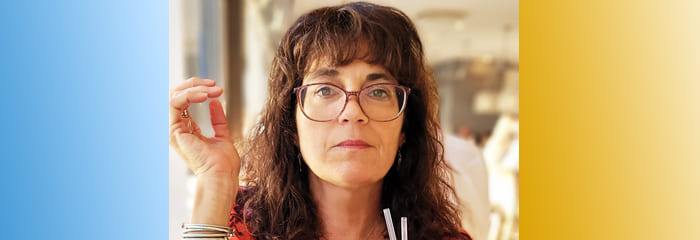


This week on Cattitude, Michelle Fern welcomes author Louise Ross to discuss Slow Blink: A Memoir, a moving and mystical story about a stray black cat named Archie, the mysterious bond between cats and humans, and how love and grief can linger across time. Louise shares how Archie entered her life, why the feline “slow blink” became such a powerful symbol of trust, and what cats can teach us about loss, letting go, and opening our hearts again.
Listen to Episode #308 Now:
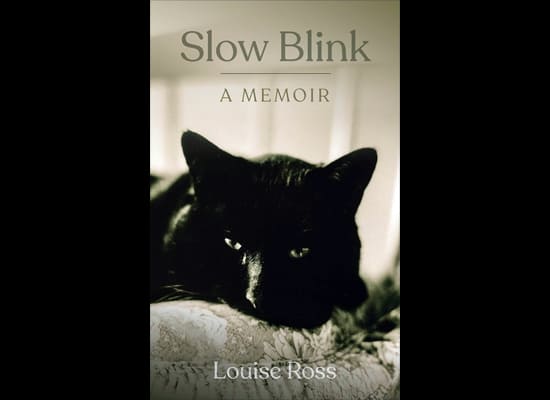
Slow Blink: A Memoir
BIO:
I’m a writer originally from Australia. Since the mid-1980s, I’ve lived across four continents. In 1989, I completed an MA in Jungian Psychology in the United States, and in 2014, I moved from Colorado to Lisbon Portugal, where I currently live.
In April, 2025 I turned sixty-five. Mid-sixties feels like a significant new phase of life, the beginning of my ‘third act,’ and thus I consider this not merely a new chapter, but an entirely new volume in my creative writing life.
My previous writing presented on this website includes: a Master’s Thesis, Clarification of Jung’s Concept of the Archetype, completed at twenty-nine; travel articles written in my early thirties; two romcoms Baking at Midnight, and Breakfast at Tildy’s, from my early forties; Market to Mouth, arecession-strategy food blog written during the 2008 financial crisis; followed at fifty-three by an illustrated children’s book, Roger and Simon the Goose Fly South; and from my late fifties, two interview-based biographies: Women Who Walk and The Winding Road to Portugal. Each work emerged from a particular phase of my life.
Now, entering this third act, I’m working on projects that reflect where I am today. The Dressmaker’s Daughter (working title), an autofiction memoir of my mother’s life in 1950s Melbourne as a fashion designer, a career she gave up to marry my father and move to rural Australia to begin a family. Conversations with the Unconscious (working title), a personal memoir in which the narrative weaves together timelines from my life, and selected dreams from my journals that illuminate major life transitions. The third project I contemplated for 35 years and completed in 2026: Slow Blink: A Memoir recounts my relationship with a stray black cat—a meditation on grief, wonder, and the mysterious threads that connect us across species, across time, and across the veil.
Transcript:
Hello, feline friends. Welcome to Cattitude. I'm your show host, Michelle Fern.
And today, I have an amazing author who's going to share her book with us. And I am just very excited to have her on. It's a memoir.
And I think all of us with cats can relate to this book. We'll be right back. Welcome back, everyone.
I'd like to welcome Louise Roth. She is the author of Slow Blink, a memoir. Louise, welcome to Cattitude.
Thanks so much, Michelle. That was a lovely introduction. Well, it's lovely to have you.
I love your accent. So you're worldly. So we were talking a bit before the show.
You're Australian. You're based in Portugal. You've lived in the US.
Do you find cats different in places you've lived or they're pretty much all the same? You know, here in Portugal, well, particularly Lisbon, where I live, you never see them on the streets. They're indoors. And probably the reason they're not on the streets is because the streets are crazy.
The traffic is crazy. The streets are tiny and windy and cobblestones. So, you know, presumably people keep them indoors because they're safest.
Whereas in the US, of course, I lived in Colorado. Cats were indoor, outdoor in the winter, mostly indoor. In Australia, it's quite different now because cats have decimated our bird life.
And Australians are very into their environment, now wildlife and now flora and fauna. So there are rules now about keeping your cats indoors. And if they're outdoors, they need to wear a bell around their neck so that they alert the birds that they're coming, which, you know, I think's a good thing.
I love that. I have goosebumps. Didn't Australia also just did something? I think they stopped decline nationwide or they did something nationwide, but I can't recall what it is.
You mean regarding cats? Yes. You know, I don't know, Michelle, but the one thing I'm very aware of is the bells around necks. And the preference is that you keep your cats indoors.
I agree. I agree. I live in a warm climate and my cats are indoors.
They have a catio, but they can decide if they want to go in or out. And in some areas that's more rural, they could be outside, but mostly I say keep them indoors. Okay.
So let's talk about Slow Blink. Okay. First, I'm so curious, what made you decide to write the memoir? What inspired you? It sat with me for 35 years, this story, because it happened when I was probably around 30, I'm 66 now, when I was newly married, living in Boulder in Colorado.
And this stray cat lived on the premises of the townhouse complex where we lived. And the story really happened over the course of about a year. And it was quite extraordinary for me.
And I'll fast forward and say that it was quite magical, mystical, otherworldly. Several of the experiences I had with this feral cat, so much so that when I shared some of the things that had happened, people didn't believe me. And when people don't believe you about mystical experiences that you have, you tend to sort of shut down or keep quiet about it.
And particularly back then, that was 19, the late 80s, I think, the late 80s. And as a young person, as a 30 year old, perhaps I still didn't have the kind of voice that I have now. And so I just shut it away.
I put the story away, the whole experience away. I did actually initially write it on little cue cards, because that's sort of what you did in those days as a writer. If you had ideas, you journaled them or you put them on cue cards.
And I kept those cue cards for years, even moving countries. And then finally, at some point, I let them go. I let those cue cards go.
But the story never left me. And I moved apartments two and a half years ago. I used to live out on the coast and I decided, well, I'm going to move into Lisbon and have a city experience.
And when I did that, I wasn't particularly comfortable in the apartment in which I moved to. So I thought, I really have to get into a creative project. I've got to do some writing, because that's what I tend to do.
And the story came back to me. And as happens, I think, sometimes just synchronous events occur and you feel compelled to pull up an experience perhaps that you've put away and do something with it. And that's what happened.
It was actually a movie I saw. It was the 2025 animated movie that won the Academy Award called Flow. And it was about a black cat that goes through some pretty harrowing experiences.
And because of its cross-species connections with other animals, it manages to survive a cataclysm. And it was almost like I was seeing Archie, this stray cat that had come into my life 35 years ago on the big screen. And so that was the synchronous event.
Yeah, I came out of the movie theatre thinking, it's time to write the story. So I just sat down and I wrote it in about six months. That is quite a story about your story.
Wow. Yeah. I think times have changed.
I don't know if times have changed. I'm one of these people that I think things happen sometimes that are unexplainable. And coming from, I have my, definitely have my left brain experience because I have two business degrees.
So here I am, you know, in grad school, we actually had a class about a shaman and crystals, because you need to sometimes think differently than you do. You know, you have to think out, open your mind. And I think that's one thing cats do to us.
They make us open our mind. We don't have a choice. With dogs, you don't have to be, I don't think, and I'm a dog person too, I'm both.
But you know, dogs, friendly pet, nothing's gonna happen. Cats, you have to know them. You have to have that understanding with them.
You have to get them. Tell us about the stray black cat that is the hero of the story. Okay.
Well, as I said, he appeared in the townhome complex where my husband and I lived. And he was probably about two years old at this point. He was in pretty good condition.
He was living out of the dumpster, bless him. And when I would come home from work, I would approach, try and approach him. He wasn't, he was very skittish.
So he would sort of run off. But I would always just say, hi, kitty. And I was always curious about where he was from.
Perhaps he lived close by, but increasingly, I was aware that he was always around the dumpster in the townhome complex. But there was a day when I was upstairs working from home, and we had a balcony that was abutting the upstairs, one of the upstairs bedrooms. And I was just at my desk working away.
And suddenly there he was staring at me through the sliding glass door. And I stared back at him. And we had this moment where I realised he was just as curious about me as I was about him.
He was watching me. And I felt that he had sensed where I was in the apartment, because he had to climb an apple tree in our front yard to get up and jump over the balcony railing, to be able to stare in that glass door. And this was our first kind of close encounter.
So that was the beginning. That was the beginning of something. Yes.
And that's unusual for a feral cat. Having had two, very unusual. Let's talk about the title.
So the title, Slow Blink, has a special meaning. Can you share that with our audience? Because not everybody knows about cats and blinking. Really, really? Well, that's interesting, because back then I didn't either.
Of course, there was no internet. But I was very aware that this cat would communicate with me via slow blink. So for instance, I was very chatty with him always in order to try and, you know, build some kind of friendship with him.
He still wouldn't let me get close. So I would sort of just talk to him. Did you know that cats, and I've heard this a few times, so if I'm wrong, someone will send me an email, but I've heard from numerous places that when cats meow, it's not so much for other cats.
It's for the humans. Yes, yes. So when you say talking to your cat, I said, yeah, makes perfect sense, because that's how they don't really meow for other cats.
It's for, I mean, maybe in fights or something, but that'll be more of a meow. But mostly when they're meowing or telling us, doing something, that's to tell us, do something for me, whatever they're, you know, willing to figure out what they're doing. Yes.
And I've actually since learned, actually writing the book, I did a little bit more research about feline communication. And feral cats don't meow. They don't tend to meow.
They learn it from people. So, you know, once they become more domesticated, if you like, perhaps they're spending more time with us, and we're communicating with them and talking, that is one of the ways they begin to communicate with us. They meow.
And of course they do tell us in their meowing what it is that they want. But the slow blink is similar. And again, I didn't know that this was part of feline communication back then.
But when I would chat away to Archie, he would perhaps sit and he would just do this very slow blink. It was almost as though it was a blink in slow motion. And it was always so endearing.
It was just so sweet. And I've since learned that feline behaviorists, animal behaviorists, understand this slow blinking as the cat's way or their gesture of showing their trust and love. So that's just so beautiful.
Yes, I think it is too. And I first found that out. My most stoic cat is Molly.
So I would look at her and try doing blinks every so often. Sometimes she'll blink back. It depends on the mood.
We're getting better. We know each other after 10 years a little better than we used to. Let's talk about also, now this feral cat is black.
I've had shows on black cats, several shows. I've heard about the Black Velvet Club, which I don't know if that's just for dogs. When I adopted, I thought there was a picture of a dog, but that's for dogs, I believe, and cats.
For some reason, they're not adopted as much. Everyone that I've adopted, all my dogs were black with markings and Molly's tuxedo. She adopted us.
What do you think is interesting about this era of mystique or sometimes there's a lot of superstitions about black cats? Did that deter you or did you have any thought about that when you were communicating with the feral cat? No, not at all. I thought he was absolutely beautiful because his coat was just raven black and he had just exquisite green eyes. There's a picture of him on the front cover.
He's looking a little bit annoyed with me because I was up close trying to take a photo of him. But this superstition around black cats, I do find disturbing. I do wonder if it's because we associate the colour black with the dark, with the night, danger, the unknown, perhaps what lies beneath the surface of life.
Perhaps it's association with the deep or the mysterious parts of life and our existence. Possibly. Yeah, that we can't see or fully rationalise that that causes or generates some kind of mystique around black cats.
From a cultural perspective, and you sort of alluded to that too, black cats have been associated with the supernatural across many cultures. In ancient Egypt, they were revered and harming one was illegal. Killing a cat was punishable by death, I believe.
In the Celtic tradition, a black cat arriving at your home was a sign of prosperity. But in medieval Europe, for instance, they became associated with witchcraft and the occult. And I think that's one that particularly has infiltrated our, I don't know, our psyche as somewhat damaging, in fact.
I absolutely agree. We need to take a short break and we'll be right back. Welcome back, everyone.
We're talking to Louise Roth. She is the author of Slow Blink, a memoir. So Louise, I want to ask you about this.
Your book is about several things. I mean, it's about loss. It's about grief.
It's about loving something that you can't keep. I mean, a lot of people have experienced this and I know it's two different things. Grief, well, maybe intertwine a little and then loving something you can't keep.
What do you hope readers take away from your story that relates to those feelings? Well, I think one of the things that I kind of conclude the book with is this idea that love doesn't end when letting go begins. It simply changes form. And the grief is not linear.
It doesn't follow a tidy arc from loss to acceptance. It circles back. And as in my case, it ambushes you years later and it hides inside other losses, which I think I sort of try and weave that through this story.
Writing Slow Blink 35 years after Archie died taught me that grief has its own timing and that unprocessed grief waits until we're ready to process it, to meet it. Also, animals give us permission to grieve. There's still a cultural tendency to minimise the loss of an animal.
It was just a cat, which I know some people have thought when I've shared something of Archie's story with them. And this kind of really fills or leaves you feeling isolated in your grief. And I hope Slow Blink gives readers permission to take their grief seriously and to honour the depth of what they felt, the connection they had with their kitty, because the bond was real and the loss is real.
So I suppose I hope readers take away that your grief for your cat is not small. It's not embarrassing. It's the resonance of something profound that happened between two creatures from very different worlds who sound each other.
That's an amazing way to put it. That's how I felt. Amazing.
Now, did you adopt other cats after Archie? You know, I didn't. This also might sound, I don't know, odd or not bizarre, but I loved him so much, so profoundly that when I lost him, I thought I could never have another cat. The pain was just too great.
And he was so beautiful and so unusual. And the experience was so otherworldly. I felt it surpassed what I could ever give another cat.
Now, something is shifting. I mean, 35 years later, a lot has happened and I still have a sense that Archie is around me. And I do think one day, yes, I'll open my heart to another cat because every now and then I encounter friends' cats and I just love them so much.
I think I'm almost ready for another one. Well, we each have our time, you know? We do. We do.
Some people, you know, we need to adopt right away. Some people just can never do another. That's their cats all made for life.
Yeah. I don't know. Mine find me, so I don't know what to say about that one.
Well, they do. I think that's one of the mysterious things about cats is that they find us. Why do you think they do that? Is it food? Like, how do the cats? I live in a warm climate, so there are sometimes other cats around and so forth.
I wonder how they know this is the house that will feed you when there's just a, we do have a water fountain outside just for cats. Is that the giveaway? Do they just know who to go to? No, I think that there might be something to that. And of course, the rational side of me always feels like, oh, they're very much food driven.
And as I understand it, cats came out of Africa, that domestic cats are still genetically are very much connected to wild cats of Africa. And as communities and civilizations encroached on their space, they sort of lived at the periphery. And of course, living on the periphery of villages, towns, cities, they had access to food.
So it may well have been very food driven. But of course, as all your listeners will know who have cats, they're very independent. And they have maintained that sort of, I don't know, African wildness about them, that African wild cat quality about them in their independence.
And so, yes, perhaps there's an element of them being food driven. But I think also over eons, they've learned that human companionship probably offers them more than food. And I don't know what that is, because there's something very unknowable about cats.
Again, coming back to this idea, there's something quite mysterious about them. They seem to sort of observe and watch us, but from a very detached place, unless they're ready to be stroked or comforted. Yes.
In a way, I think that's smart. They have their way of saying, leave me alone. When I want you, I'll let you know.
I'll let you know. Exactly. That's actually smart.
Too bad that as humans, we can't really do that sometimes. So, what do you hope that readers, when they read Slow Blink, take away from your book? I really do think it's as simple as love persists even when we must let go. There's solace in this persistence of having loved, however fleeting and however inexplicable that connection is.
It doesn't die with the body. It continues. And so, in times of loss, I think we can draw on that.
And I think that that's what I wish for, for readers of Slow Blink. And what would you tell readers that read your book and listening to you thinking about adopting a cat? Some people can hear about, with everything, there's joy and grief, you know, there's contrast. So, for somebody reading and listening to you saying, oh, I want to adopt a cat, but it'll be hard if something happens or, you know, what would you say to those listeners? Oh, gosh.
I think if you're drawn to caring for an animal, go to a shelter, visit with the cats, see if there's a particular cat that you're drawn to that's drawn to you. I think make genuine inquiries at the shelter about what's involved in caring for a shelter cat, because oftentimes that can be traumatised, they might have been abandoned, they might have been abused. And there's a responsibility in caring for a cat from a shelter.
And I think, personally, this is just my personal feeling, that it's important that we understand the responsibility of care. And so I think just make inquiries, open your heart, and make inquiries, go to a shelter and investigate. Thank you so much.
Louise, where can our listeners find your book, Slow Blink, a memoir? It is on Amazon. That is actually the only place that it's available for purchase. So you would just go to Amazon and put in Slow Blink, a memoir by Louise Ross.
And it's also available on Kindle. So that's the softcover or the paperback and the Kindle version. Okay, thank you so much again for coming on Cattitude and sharing your story with us and telling us more about Slow Blink, a memoir.
Thank you so much, Michelle. I hope everyone enjoyed the book. Again, it is called Slow Blink, a memoir by Louise Ross.
Thank you for listening to our show today. I want to thank my cat crew, Dennis, Charlotte and Molly, who I had Slow Blinks with all of them at one time or another, mostly Dennis and Molly. Thank you to my listeners of Cattitude.
I appreciate you so much. Again, thanks to my guest, the author, Louise Ross. Thank you, of course, to my amazing producer, Mark Winter, for all you do.
He works his magic and makes every show sound amazing. And always remember, lose the attitude, have Cattitude.