
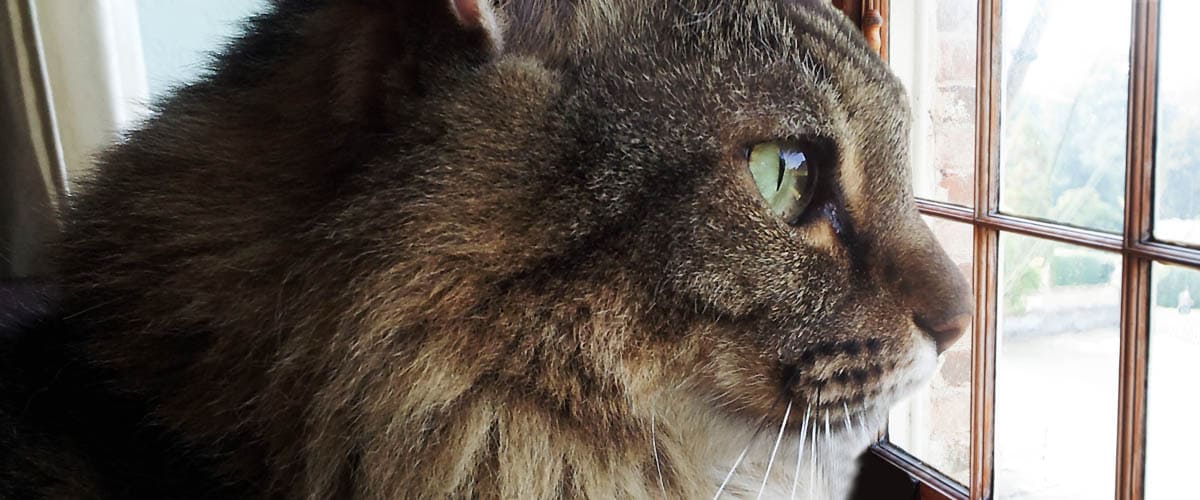
Your Cat Is Talking—Are You Listening?



What if your cat could tell you exactly what they're thinking? This week on Cattitude, Michelle Fern welcomes animal communicator Zan Ottaway, whose approach combines intuitive communication with an understanding of animal behavior. Zan explains how she connects with cats, why she believes anyone can become more receptive to what their pets are communicating, and why cats aren't being spiteful when they act out—they may instead be expressing insecurity, excitement or stress. Michelle even puts Zan's ideas to the test with her own misunderstood cat, Charlotte, as they explore one of the most frustrating feline problems of all: litter box issues. The conversation also takes a touching turn as Zan discusses how cats grieve, communicating with pets who have passed, the guilt many pet parents experience after losing a beloved animal, and her work helping rescue animals. Whether you're a believer, a skeptic or simply wish your cat came with a translator, this episode may have you looking—and listening—to your feline companion in an entirely new way.
Listen to Episode #314 Now:

Paws, Purrs & Telepathy: Inside the Secret Language of Cats
BIO:
I've been practicing Animal Communication for over 10 years and love being around animals and delivering their messages to you. I do pet telepathy, work with behavioral issues and offer energy healing. I can speak to your companions individually or as a group (as in multi-pet households). I do ask you to email or text me photos of your pets with their eyes wide-open, and their names and ages but you don’t have to.
You may also want to tell me the issue of focus!
A lot of what I do is based in meditation as I've found that many illnesses and behavior issues are often stress-related and meditation is very good at attracting animals to their people.
First we get quiet and listen to what your pet is thinking, feeling and seeing. I telepathically ask your animal or animals a few questions, just let them speak.
You may ask questions or take up a behavior point we can work with, and after communicating about that then we can scan his/her/their body and do an energy healing. We try to end with a few moments of silent meditation or a prayer.
As we heal them we are healed and we include the whole household, animals near and far, farmed or wild, all over the world: land, air and sea, in our sessions. All species welcome.
Transcript:
Hello, feline friends. Welcome to Cattitude. I'm your show host, Michelle Fern.
Did you ever wonder if you could understand what your cat is thinking? Well, my guest today is an animal communicator. And boy, would I love to know how to do that. She's going to talk to us about all kinds of things.
So stay tuned. We'll be right back. Welcome back, everyone.
I'd like to welcome Zan Ottoway. As I said in the intro, she's an animal communicator. Welcome, Zan.
Thank you, Michelle, for having me on. I'm so excited to have you. So I've been doing Cattitude for a while now.
Wow. Next year will be 10 years. So I've had a few animal communicators on in the past.
So I have an understanding of what they do. And one actually gave me some info on my misunderstood cat named Charlotte. But a lot of people, while they've heard of animal communicators, they're not really sure what they actually do.
Your approach is a little different because it combines intuitive communication with behavior analysis. So what actually is this and what happens during a session? Well, you know, Michelle, it's gotten to the point where I'll give you a choice. Like, do you want to talk about common sense causes and rule out medical things first? I usually like to rule out medical things like have you been to the vet about this.
But sometimes some people want to go right into the meditation. So I ring the bell, we start a meditation. I try to be quiet, but sometimes I just flip right into it and start, you know, getting information from a cat.
And I'll try and make a few notes. And then when I feel like they're done, like just a two minute meditation, I'll start saying, well, your cat said this, that and the other thing. And does that make sense to you? And if it makes sense to them, it really helps us get into tap into that connection between the owner and their animal.
I do have a few questions I can ask animals, like basically, who are you? How are you? A couple of things like that. But sometimes the animals want to get right into it. They know what their people want to talk about, or they want to get right into the situation and start telling me things about their lives.
And that's where you're not leaving. If I'm just hearing silence, I do have ways of kind of try to telepathically ask, you know, well, how is it going? And how did you feel when you did that? And, you know, how can we help you with this? Okay, so I am curious, because I have a hard time understanding my cats, just understanding them, their visual cues. I'm getting better, especially with Molly, because, you know, she's a little diva and swipes and stuff.
So which is normal cat behavior. I know. So I'm getting better at reading her.
But you not only can obviously read cats well, you can actually communicate. Would you say it's a gift? Is it something that people can learn? Oh, well, you know, Michelle, you know what they say, the more you pay attention to something, the more it grows, right? Yeah. So yeah, anyone can learn this.
And there's a book by Penelope Smith, if you ever want to do it. It's called Animal Talk. And if you go to the directly to the chapter where she has a step by step guide for how to get in touch and ask about something, but there are also common sense things like if my animal was swiping me, I wouldn't reward it with a treat, right? What I've learned with, you know, because I grew up with dogs, and then cats adopted me about 13, 14 years ago.
But I've learned, you know, swiping is not like, oh, she wants to attack me. This is her way. And this is DNA, her way of saying, okay, enough, except she has claws.
You know, it's not like people where they put up their hand enough or can say verbally enough. She just, you know, swipes, but I've gotten faster. So I usually, she usually misses me.
So I'm getting better. That's so funny. I had an issue with claws at one point.
And I talked to this animal communicator named Ginger Hendry. And she she tried to say, well, a lot of times when he's calling you, it's out of love and affection, isn't it? And I said, Yes, it's kind of, he's kind of clinging on to me. And she somehow we talked and after talking to her, he kept his claws in more.
Sometimes Molly will pat me not too often, but you have often said that don't lead the witness. So what does that mean with regards to cats? Well, actually, I didn't say that myself. But I sometimes do ask some certain questions.
But what I mean is like, just jump into mediumship. Like I wouldn't go up to Michelle and say, do you have a mother in spirit? You know, like, and or you don't do you have a father in spirit? Well, no. Do you have a cousin in spirit? You know, like, I wouldn't go to you and like fish, I wouldn't just say, well, your cat likes something obvious that all cats like.
This is sort of like a Barnum statement, you know, like it applies to all cats, it wouldn't make any sense. But I just give what I get. Like I might say, what do you feel you need? And he might answer that directly or he might or she might answer something else.
And so we'll go with that. We'll go where the cat's going. And I'll give I'll just as they say is give what you get.
I just try to give what I get. And I actually never said don't leave. But it's important.
Like if I do get something it's important for it kind of helps the guardian or the owner can verify that it's real so that they can feel like they're really having experience talking to their cat. That makes sense. And then it lends a little more focus and warmth and reality.
Let me ask you this. I know there's ways to look at your cat and pay attention and read what they're saying. And they do communicate to us.
Like I said, you know, prior sometimes through their claws, but sometimes not. What signals do you think that parents miscommunicate, especially because cats are such stoic creatures? Oh, good point. Well, I think what you said is what I was going to say, which is that they're not trying to get back at us for something that like they're not trying to get revenge.
Sometimes they get very excited and sometimes can't handle their energy, but they're not spiteful. They're very often expressing insecurity or excitement, or they just lost control. They just lost control of their energy.
That could be. That could be. It's good to know that they're not spiteful because, you know, you feel that sometimes.
It's like you're hitting their head all of a sudden. Let's talk about before the break. One of the biggest reasons I think what I know that cats are surrendered are litter box issues.
I myself have, I call her misunderstood, Charlotte. Litter box issues. She was feral and I think she just missed it.
She was, you know, a few months Her sister that was a kitten has no problem from a leather letter, has no problems with the letter box, but litter boxes are a big issue. How do you start to unravel what's going on with the cat? That's a tough question because you're saying your cat was never trained to do it in the first place. Like she was trained somewhat, but she was afraid of it.
Okay. And there's plenty of litter boxes. She has her own space.
I've gone through everything. Yeah. Let's think about it.
First of all, I want to understand, make sure they don't have a UTI or urine crystals, but that would be an emergency if they did. But I also want to ask, you know, are they healthy, but also was there a change as there's been a change in the environment? But also do they like, cats really care about the smell and the feel of the, we call it the substrate, which is, do they like their litter? Like what's on the ground? We've tried all of that. Oh, I have bought more rug shampoo than I've probably, like I go through one or two a month.
So I think it's because she was feral and just, you know, out there for maybe four to six months in the wild. And she's just, you know, does not want to be trained and tamed and she's just fearful. But she lives with two other cats and I know there could be issues with other cats, but there's plenty of space.
And even when she's by herself, like say on a closed in patio, there's a litter box there. She doesn't use it. It's only her.
She doesn't use the litter box. She goes outside and it's not too high. It's not the litter we've switched around.
I think she's just either afraid of it or I don't know. You seem to know the situation very well, but we can get into the thing where we say, how can we make it easier for you to use the box? So it might be okay if she's partly an outdoor cat, then she goes outside. It might be okay, but.
No, she's not. She's only out and it's a closed in patio, but I'm in South Florida. So they'll go out if they like to, because it's when it's not hot sometimes at night, but she's not outdoors.
She comes in all the time. That's where the, you know, rug shampoo comes in. Oh, I'm so sorry about that.
Well, what I learned from Dawn Ellen is we'll say, you know, were you aware this behavior is upsetting Michelle, you know, and I feel like it would do better if I had a picture of Charlotte, but, or if you could describe her to me, like, but anyway, were you aware that's upsetting? And then how could Michelle make it easier for you to use the litter box? And what's the problem with the box? And are you afraid the other cats are going to get you? Or is this just something you don't like about going in a box and, you know, how can we make this whole thing easier for you and see what the cat says. And then, then we try to imagine like a movie of the behavior we want. We sort of like manifestation, you know, we try to manifest a video in our mind, and we transmit it to the cat saying, this is how I imagine you like going to the litter box without sacrificing your dignity and your pride.
You know, you can still be a wild cat and go to the litter box. And it doesn't mean you're less of a cat. And we visualize this, we visualize her going maybe on the catio.
I don't know what her relation is with Molly. But, and then another thing we can do, and we imagine, all the rug is clean, the rug is clean, and it smells like a nice mix of humans and cats, but not cat urine. And imagine a video of the rug being clean, and the cat walks across it and goes right to his box, or her favorite, sorry, her box or favorite box.
And then another elastic thing we can do is say, you got to imagine the video every day, you know, and then another thing, sometimes there's just too much tension in the house. And I'm not saying that's this case, but we'll try to, you know, have everybody meditate once a day together as a group. And everybody, you know, can have time to be quiet, maybe check in with messages, but have a quiet time once a day and just settle down the household.
I mean, animals need to exercise and have fun too, but just some quiet times in the day. But then also, you can put a picture up on the wall of your cat looking relaxed and peaceful, and hopefully clean. And just imagine, as well as the video, you can also have a picture on your wall of your ideal cat and how they would behave and try to transmit that.
I will try all of the above, because something will work. I like the idea of the video, you know, the manifesting. I like that idea.
Okay, we're going to take a quick break, and we'll be right back. Welcome back, everyone. We're talking to Zayna Attaway.
She's an animal communicator. So you know, one of the horrible things about, you know, being a pet parent is that, you know, they go over the rainbow bridge. They don't live as long as we'd like them to.
Yeah. What do you do with grieving? Because us humans, we grieve one way, but do cats grieve differently? And what are the signs? And, you know, do they grieve differently than dogs? Do they grieve at all? Like I said before, they're, to me, they're so stoic creatures, I wouldn't know if they. Oh, yeah, no, they really are not.
Except, oh, yeah. When Nikki passed before and he was really sick. Charlotte stayed next to him the whole time.
So that was interesting. Yeah. Oh, interesting.
So Charlotte, then she knew that he died, right? Yeah. Or he was sick. Yeah, I think so.
Okay. Well, the thing is, sometimes animals don't have closure. Both cats and dogs can vary in how they respond depending on their personality.
But I always feel like I picture a dog that he keeps running to the door to see if the father came home. He's running to the door to see if the father came home. Whereas, like when I was working in Dick and Humane Society, there were all these cages with cats, but the older ones, and they all have a reason why they were surrendered.
And the ones that were surrendered because their owner died. They have these giant big eyes. They have really sad eyes.
It's so haunting. And I'll never forget those. I mean, dogs can look sad about that, too.
But there's something about a cat that was just, you know, cut off from their owner by death. And you don't know if they were abandoned for a few days, or if whether she knows what happened, why didn't my owner come get me? And so sometimes in animal communication, we do talk to an animal and say, well, Fluffy's not coming back in ordinary reality. But she's all around you.
She loves you. And she will be guiding you. She'll be your friend.
She wants to see how you get through this next big thing. She wants to help. I would rather only say that, though, if the animal and spirit is really giving me that.
So the animals heal each other. I believe that. Definitely believe that.
And you work with both living and deceased pets, mostly cats. Are the messages different between them? That's a really great question. Because technically, you can ask the same questions of a living or deceased animal and get good answers.
But I do feel like animals in the afterlife are, they speak a little bit more symbolically. And they also come back with messages of forgiveness. Because don't you think, Michelle, a lot of people beat themselves up over the death of their animal, their cat, they beat themselves up, like, what if I'd done this? What if I'd done that? If I just called the vet the day before, la la la.
And the animal will often, more often than not, they come through and they're, that's like, it's all right, you did the best you could. They speak more symbolically than a cat who's alive might not be as philosophical as a cat in the afterlife, I feel. Like when I'm doing a lost cat, a lost cat case, if the cat says I'm all around you, it's not a good sign they're alive.
Although the ordinary pet detectives will say never give up. It's like, you could find a cat after six months. But yeah, so when I'm doing one of those detect, not detective, but when I'm doing a lost cat, I get a weird feeling if the cat's speaking very abstractly and philosophically.
Okay, very interesting. You mentioned that when you do work for the Dakin Humane Society, so you donate readings for rescue animals. And I love that you support the Humane Society.
I've had my cats found me, but my fur babe, Mr. Zeus, who has since passed on, I got from the Humane Society. And he was a treasure. He was my little angel boy.
The same Humane Society or a different one? No, another one happened to me right before a hurricane. And it was an interesting story. So you donate the readings.
What do you do when you donate readings? And why is that so important to you? And does it help with adoption for the animals, for the cats? Well, I feel that my husband, my late husband never felt like he should charge because he was agnostic. He didn't really believe in it, but he thought I was helping people. And he thought it was a good thing, but he thought we shouldn't charge for this or we don't need to charge for this.
But also I feel like Dakin Humane is very well run. It's efficiently run. They look out for themselves.
They're tough. They're good with money. They're tough, but they stay abreast of best practices.
They go to all the conferences and find out what is the latest thing about spaying and neutering. And what happened with them is they spayed and neutered everything. And so they almost had no pets left that were fit to give to adopters.
So they realized that they had to do it on a case-by-case basis. But then there are other places like say Georgia or California or Texas where they really should just keep spaying and neuter everybody because there are just too many animals. Yeah, Florida too.
Oh, Florida too. Okay. I feel like it helps people and animals.
And the last time I was there, I saw a young Latino man and his wife cuddling a Tortie kitten. And that's my favorite part of volunteering, when you help facilitate the match. I mean, they usually do it on their own, people and cats.
But it's just a great feeling when they find each other. And I found my last cat there. And I would love to have a cat find me.
That sounds fun too. That is such a great moment. Yes, it is.
My cats adopted me. They just started coming around and were born on the doorstep. Well, one, Molly was.
Charlotte is her older sister. Oh, okay. From different misters and different, yeah, obviously older sister, different letters.
Well, if I saw a picture, it would help me to see a picture and their name. Well, you gave me the names and the ages. I usually work with a photo or on Zoom.
But there is somebody nearby me, an animal communicator that just works off descriptions. But I feel like there's less of the feeling that it's evidential. Because if you describe your cats to me, then I could say, well, I know this and that.
And I could assume things. I guess I could assume things for the picture too. But I feel like I look into their eyes, and that helps me get this connection to them.
Yeah. Well, Dennis is on Pet Life Radio on my page. He's the editor.
Dennis, that's the third cat. Dennis was abandoned. When he was little, he knew the sound of the refrigerator.
So that's how we knew he wasn't out in the wild. And he was pretty well kept. And he was a good first cat because he's part Maine Coon.
And I found out later that they're called the dog of cats, which is a good starter for someone who's never had cats before. And he came into my life 2008 or 2009. So we've had him a long time.
He's like my old dude, and he's chill. And then Molly's a tuxedo. And Charlotte is a tabby.
And Molly's large. Charlotte's larger with this skinny tail. It sounds unflattering, but I think they're kind of cool looking.
She looks like an armadillo. Her body shape. Oh, that's cute.
So she's kind of round and has this little skinny tail. Oh, you have a tuxedo tabby and a Maine Coon. That sounds like a wonderful family.
Yeah. We have a little bit of everything. But he's a mixed Maine Coon because he's not a large one.
He's the smallest. So he's mixed with something, but he's part. He's just so chill.
Let's talk about this before we run out of time. Thanks for letting me share my cats with you. Let's talk about people that are skeptical because we have a wonderful cat listening audience.
But a lot of these people I'm saying, yeah, sure. I mean, how do you really do you really talk to cats? How do you really get that? What would you tell them? Well, myself and my clients, we do experience it as mental telepathy, but you don't have to believe in it, right? The question is, does it help the family, right? The question is, did you find it helpful? You don't have to believe any theology or I'm not trying to prove the afterlife. I am a little bit of an apostate because some of my teachers really think they're proving the afterlife by science and I don't claim to prove it.
So the question is, I don't have to change my spiel or my talk or my session all that much, even to accommodate like an atheist or an agnostic. I don't have to change all that much, but they might be a little less believing. But in the end, though, did we fix the problem? Like once my husband, we couldn't pill his cat.
So I went into a session where I read Penelope Smith Animal Talk and I communicated with the cat from a distance and said, like, how do we get you to take your pill? And she said, easy, just give me a snack. And this was back in the days before we really knew the cats could be trained. This was back in the 90s or no, I'm sorry, it might have been 2000.
So we gave her a snack next time we pilled her. And then after that, she was lining up on top of the washer dryer. She would come up every time at four or six or whatever time it was to get her pill and her snack.
And she just took her pill and got her snack and it was easy as pie after that. So that was a simple example. But like after that, my husband didn't care if like telepathy is real.
You know what I mean? Right. If it solves the problem. Yeah.
Right now I'm going through some little issues with Molly and I have to care for her and it's messy. She's a little too chubby to clean herself. Let's put it that way.
So a little bit or she's losing her flexibility. She's almost I think she's almost 10. So every time she sees me coming near her with a latex glove and wipes after like hide it, I go around the corner of the pantry where she knows that, you know, I keep the gloves.
She like looks around. But I talk to her ahead of time and let her know. So it's not like I'm I don't think I'm communicating to her.
I don't know if she knows, but she knows it's for her best interest, even though she doesn't like it. And she does come around to me after. It's not like something when people think, oh, if I do this thing and I and my cat doesn't like it, then they kind of hate me.
And, you know, I just can't do that. That's not the case. She knows I'm helping her, even though she doesn't like it.
She howls and she doesn't hiss. Oh, well, if you warned her in advance, you didn't run away. It sounds like you've done it, you know, every day.
Wow. We do have to fool them sometimes, but it sounds like you're not trying to fool her. I am someone else.
My husband holds her and then I clean her up. But she doesn't avoid me. You know, she doesn't like stay away.
Right. It's done. I guess she knows somehow it's to help her.
It's in her best interest. It's to make her less irritated and, you know, get cleaned up out there so she can take care of herself hopefully soon. But she comes right around to me afterwards.
So I think she does know somehow that maybe she understands me. Maybe, you know, I don't know, is this animal communicating? Yeah, I think so. I mean, she realized it's part of life, right? And you trained her.
It's training. And it's helping her even if she doesn't like it. Well, part of it is actually ordinary reality training.
And part part of it is I think you are communicating to her because you're letting her know and she didn't run away. Right. You tell her beforehand what you're doing.
I let her know beforehand. And she didn't run away. I have to be a little strategic and she doesn't run away.
She goes from the couch down to the floor. Then we have to convince her to come back up to the couch. So she's not 100% happy with how I'm communicating.
Sometimes she waits, but I have to still be sneaky. So maybe I'm not communicating that well. Oh, I don't know.
It sounds pretty good to me. If you're just if you're getting it done, you know, I'm getting it done. I have to get it done.
So it doesn't hold it against you for too long. I keep telling her you can do yourself. I'm done.
And I can't wait for that day. So you know, I don't know sit ups or something. Cat yoga.
So you know, looking at the future, what do you help people take away from your work? Oh, okay. Well, mainly, you know, the main one is don't declaw, right? Oh, of course. But learn to meditate and sometimes going to a group once a week can help with that.
But also, don't punish bad behavior, but you can you can withdraw your attention, but don't punish it. But definitely reward good behavior and try to shape good behavior with words of affirmation and treats like I like not but true. But yeah, just that we don't punish them.
Right? I definitely get that. Is there anything else you wanted to add before I ask where people can find you? We all love our cats. It's been a great time with you.
You're very charming hosts and very interesting. And my website is z a n o t t a w a y.com. So on the page for this show at petliferadio.com. There's a link to your website and your photo. Oh, fantastic.
So yeah, so there's a page where people can find out more about you as well. So thank you so much for coming on Cattitude. Oh, my pleasure.
And thanks. Thanks so much to you. It was some it was fun.
Okay, great, great. I'm glad you liked it. I hope you enjoyed this show.
I certainly did. I think there's something so fascinating about animal communicators. And when someone that can communicate with my cats, oh my gosh, yes, I'm all for it.
So thank you, Zane for coming on Cattitude. Thank you, Dennis, Charlotte and Molly for talking to me and teaching me about cats. Thank you to everyone listening to Cattitude.
I appreciate your loyalty. Thank you so much. Almost 10 years of Cattitude.
Wow. And of course, the show would not be the same without the magic of Mark Winner. Thank you so much, Mark, my amazing producer.
And remember lose the attitude have Cattitude.